
Published: July 2026 · Category: Outdoor How-To · Reading time: 8 min
Executive Summary
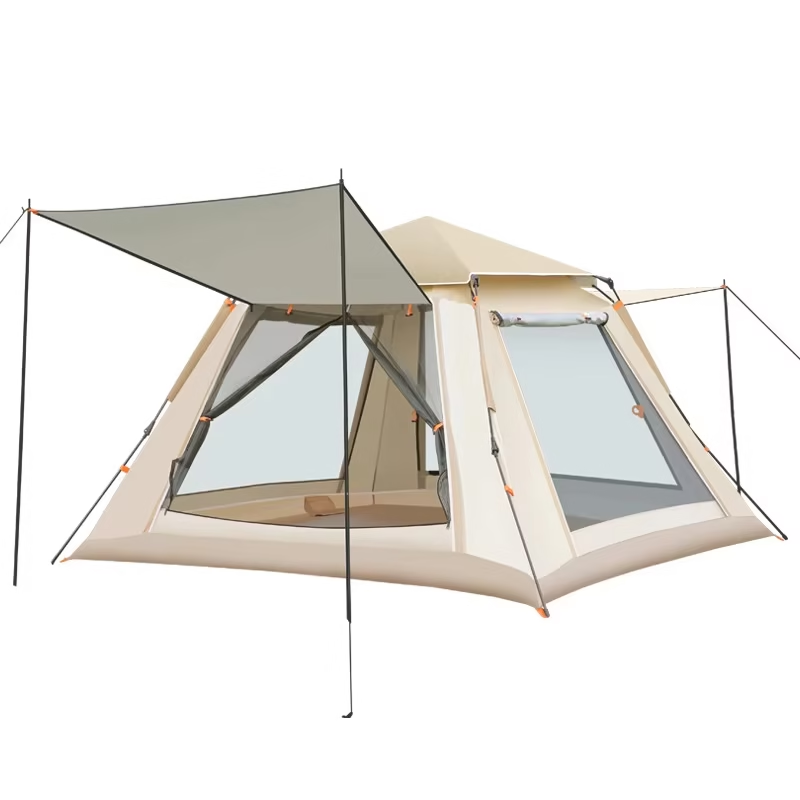
Camping tent specs look like alphabet soup until you translate them. Two tents at the same price can target completely different buyers — one a three-season family car-camping unit, the other a four-season mountaineering shelter — and the spec choices that distinguish them matter most to camping tent wholesale buyers planning seasonal orders months in advance.
Most camping tent wholesale buyers entering the tent category buy on look, photo, and price, then get caught by spec gaps that lead to returns, missed seasonality, or worse — a tent that fails on its first weekend of rain. This guide covers the eight specifications on a tent spec sheet that actually matter for wholesale decisions, the four-season vs three-season difference in plain terms, and the seven common buying mistakes that show up across North American retail orders.
The trends below are grounded in publicly available industry data, not any single supplier’s catalog. Verify specific figure ranges against the current season’s wholesale price list before quoting landed cost.
Why tent spec matters more than tent price
Tents are the highest-claim / highest-fail category in outdoor wholesale. A jacket that fails feels mildly uncomfortable. A tent that fails in storm conditions ends in bailing out a customer at 2 a.m. on a Switchback Trail in Colorado. Word travels fast about which brands do and don’t hold up.
For camping tent wholesale buyers, that means spec sheets — not catalog photos — drive return rates, repeat orders, and review quality. The price difference between a $40 wholesale pop-up and a $180 four-season mountaineering tent reflects engineering, material, and labor. If you don’t know what makes one cost twice the other, you can’t reliably judge whether a factory quote is fair or inflated.
The other reason spec matters: tent buyers from different regions expect different things. A buyer in Texas selling family campers has a fundamentally different spec sheet in mind than a buyer in Vancouver shipping to alpine clubs. Mis-spec’d stock is unsellable stock.
Four-season vs three-season: the actual differences
Marketing uses “four-season” and “three-season” to communicate weather tolerance, but the engineering specifics differ in measurable ways.
Three-season tents are designed for spring, summer, and fall conditions in temperate climates. Typical spec ranges:
- Fly fabric: 68D to 75D ripstop polyester or nylon, PU coating 1500-3000 mm hydrostatic head
- Pole structure: 2-3 cross poles, sometimes a single ridge pole, DAC aluminum 7001-T6 or equivalent
- Floor fabric: 70D nylon with PU/DWR coating, 3000-5000 mm hydrostatic head
- Mesh: significant interior mesh panels, single-wall or double-wall with ventilation
- Weight: 2.5 to 4.5 kg for 2-person, 3.5 to 6 kg for 3-person
Four-season tents are designed for winter mountaineering, high wind, and snow load. Differences you’ll see on the spec sheet:
- Fly fabric: 30D to 40D high-tenacity nylon, silicone-treated (sil/PU or sil/sil), higher HH rating
- Pole structure: 4-5+ pole architecture, often with crossing poles to handle snow load and wind shear
- Floor fabric: heavier denier (often 40D-100D), bathtub design with 5000-10000 mm HH rating
- Mesh: minimal mesh, near-solid inner tent for heat retention and wind block
- Weight: 3.5 to 5 kg for 2-person, often exceeds 5 kg for 3-person
The price difference reflects the engineering, not the season. A four-season tent from the same factory in 2-person configuration typically runs 50-100% more than a three-season equivalent. This is not markup — it’s material cost (higher denier fabric, more poles, more reinforced seams).
How to read a tent spec sheet
When sourcing from a factory, request this minimum spec sheet before pricing:
| Specification | Typical 3-season | Typical 4-season | Why it matters |
|---|---|---|---|
| Fly denier & HH rating | 68-75D, 1500-3000 mm | 30-40D silnylon, 5000+ mm | Waterproofing, weight tradeoff |
| Floor denier & HH rating | 70D, 3000-5000 mm | 40-100D, 5000-10000 mm | Wear, wet ground performance |
| Pole material & diameter | Aluminum 7001-T6, 8.5-9.5 mm | Aluminum 7001-T6 or scandium, 9-11 mm | Strength, weight tradeoff |
| Number of poles | 2-3 | 4-5+ | Storm stability, snow load |
| Minimum trail weight | 2.5-4.5 kg / 2-person | 3.5-5 kg / 2-person | Hiker preference |
| Packed size | 45-55 cm length | 50-65 cm length | Mountaineering pack compatibility |
| Vestibule area | 0.5-1.0 m² | 0.8-1.5 m² | Gear storage in storm |
| Door count & shape | 1-2 D-shaped | 2-3 with snow flaps | Entry in deep snow, ventilation |
Two specs most often missed by first-time buyers: vestibule area (real gear storage in storm) and door shape. A slit zip door on a four-season tent fails in rime ice; an arched zip or vestibule-protected door survives.
Common wholesale mistakes when ordering tents
First-time tent buyers moving from apparel or accessory categories typically hit these:
1. Buying “four-season” labeled tents that aren’t actually four-season. Many factory “four-season” SKUs are three-season designs with extra poles, not designed for sustained snow load. Ask for: number of poles, pole geometry diagram, and minimum weight figures verified against REI or Backcountry published specs at the same footprint.
2. Spec’ing for the wrong climate. A tent spec’d for Texas family camping (3-season, heavy mesh) won’t sell in British Columbia. Match the spec to your end retail climate, not the factory climate.
3. Underestimating pole quality. Aluminum 7001-T6 is industry standard; aluminum 6061 is cheaper but 15-20% weaker per weight. Fiber-reinforced plastic poles are not appropriate for any four-season use.
4. Not pricing seam-sealing as a line item. Some factories seam-seal at no cost, others add $0.50-$1.50 per unit. This is a 5-10% cost surprise on first orders.
5. Treating tent specs as universal. A “2-person” tent at one factory measures 2.2 m² interior; another factory’s 2-person measures 2.8 m². Footprint and interior height matter more than nominal person count.
6. Skipping the lab test report. REACH, CPSIA, and Prop 65 each require different tests. DWR treatments often contain PFAS compounds that fail Prop 65. Order one lab-tested sample before committing 1,000 units.
7. Inventorying three-season stock in fall. Outdoor retail seasonality pulls hardest in March-June; tent buyers who stock heavily in Q4 carry costs. Work with your factory on staggered MOQ and ask about 120-day payment terms if your buyer credit profile supports them.
Bottom line for sourcing teams
The eight specs above tell you whether you’re looking at a $50 pop-up or a $150 alpine shelter — and at what price your factory can deliver. Don’t price-shop across four-season and three-season categories: they’re different products.
Most importantly, lab-test one sample before committing to a 1,000-unit run. Two weeks of test time saves a year of returns.
About the Author
The AnttifySport Sourcing Team supports wholesale buyers, importers, and brand owners sourcing camping, hiking, cycling, and skiing gear from qualified Asian factories. We’ve worked with over 200 B2B clients across North America, Europe, and Australia since 2018, with a focus on low-MOQ custom orders and OEM/ODM partnerships for emerging outdoor brands.
Have a sourcing question or want to discuss your next product line? Reach out at https://www.anttifysport.com/contact/.
Further reading & sources
Related guides on AnttifySport and the public data sources referenced in this article.
- 📖 2026 North America Outdoor Gear Wholesale Market: 5 Trends — broader market context for Hike & Camp sourcing.
- 📖 7 Cycling Accessories Every Bike Retailer Should Stock in 2026 — companion guide for IBD owners expanding into adjacent categories.
- 📖 Hiking Backpack Buying Guide 2026: Wholesale Buyer’s Checklist — companion guide for hiking buyers building tent-included kits.
- 📖 Camping tent catalog — current OEM/ODM tent line for wholesale buyers (AS-CT-0012, AS-CT-0008, AS-CT-0015 and more).
- 🔗 REI Co-op Expert Advice: How to Choose a Tent — independent consumer-facing education on tent specifications.
- 🔗 Backpacker.com Tents — independent gear reviews and side-by-side comparison data.
Sources cited in this article:
- REI Co-op Expert Advice: How to Choose a Tent
- Outdoor Industry Association, 2025 Outdoor Recreation Economy Report
- Backpacker.com, 2026 Tent Buying Guide
- EN 13537 / ISO 23537 sleeping bag temperature standard reference
- ASTM F1934 / F2536 standard references for tent performance
Public data sources cited; readers should verify specific figure ranges against the latest available editions of these reports before making sourcing decisions based on this analysis. Spec ranges cited are industry-typical ranges and not guaranteed by any specific factory.