Published: July 2026 · Category: Market Insights · Reading time: 9 min min
# 2026 North America Cycling Accessories Wholesale Buying Guide: 10 Categories Worth Restocking (and 3 Most Buyers Quietly Skip)
Executive Summary
Cycling accessories in North America are quietly becoming a bigger margin story than complete bikes in 2026. The North American bicycle accessories market is projected to grow from $16.33 billion in 2026 to $24.73 billion by 2034, at a 5.3% CAGR, per Fortune Business Insights’ June 2026 update. Europe holds 31.55% of global share, but the U.S. retail floor is where the structural shift is happening: the National Bicycle Dealers Association (NBDA) reports over 1,000 U.S. bike shops have closed since 2015, and major brand revenue has dropped 20-40% across the same period.
The wholesale takeaway: a retailer who keeps a complete-bike-led catalog is fighting a shrinking pie. A retailer who pivots to a high-turnover accessories mix is riding the segment that’s actually growing. This guide walks through ten accessory categories worth stocking in 2026, three that are commonly skipped, and the spec decisions that decide whether your private label program scales or stalls.
The figures cited are drawn from public industry sources (NBDA, PeopleForBikes, Fortune Business Insights). Specific dollar amounts and category growth rates should be verified against your factory’s current quote sheet before committing to landed-cost models.
Why cycling accessories are the bigger margin story in 2026
Three data points frame the case.
First, the accessories market is growing while the complete-bike market is flat-to-down. Per Fortune Business Insights’ June 2026 outlook, the global bicycle accessories market will reach $16.33 billion in 2026 and grow to $24.73 billion by 2034 — a 5.3% compound annual growth rate. Bicycle sales, by contrast, have been roughly flat since the 2020-2021 pandemic peak. The two segments are decoupling.
Second, accessories have lower capital intensity per SKU. A mid-volume retailer can stock 200-300 accessory SKUs at $5-50 landed cost each without committing the same capital as 30 complete bikes at $300-800 landed. Inventory turn is also faster — most accessories move in 60-90 days, while complete bikes can sit 6-12 months in slow-moving sizes.
Third, accessories carry higher margin per square foot of retail floor space. A retailer doing 50% gross margin on accessories versus 25-30% on bikes will run a healthier business from the same rent and labor cost. This is the math that has shifted NBDA-member floor plans over the past three years.
The ten categories worth stocking in 2026
These are the categories that combine volume demand, repeat purchase behavior, and MOQ flexibility suited to mid-volume wholesale.
1. Lights — front and rear
Lights are the highest-frequency repeat purchase in the accessories category. Battery standards (USB-C rechargeable, replaceable AAA) have stabilized, and IPX5+ waterproofing has become table stakes. Stock both a $8-12 retail entry SKU and a $25-45 retail USB-C rechargeable premium SKU. Wholesale MOQ is typically 500-1,000 units per color.
2. Locks
Cable locks, U-locks, and folding locks each have a buyer. Cable locks move in commuting and e-bike channels at $10-25 retail. U-locks are the security-first choice at $25-60 retail. Folding locks are the niche premium tier at $60-120 retail. Stock at least two SKUs from two lock types to cover the spectrum.
3. Pumps — portable and floor
Two distinct SKUs are needed: a portable hand/electric pump (the daily-use “I got a flat” category) and a floor pump (the workshop/home-mechanic category). Electric pumps now dominate the entry tier thanks to built-in pressure gauges and auto shut-off. Floor pumps remain a steady seller for the home mechanic demographic. Wholesale MOQ is 200-500 units per SKU.
4. Bike bells
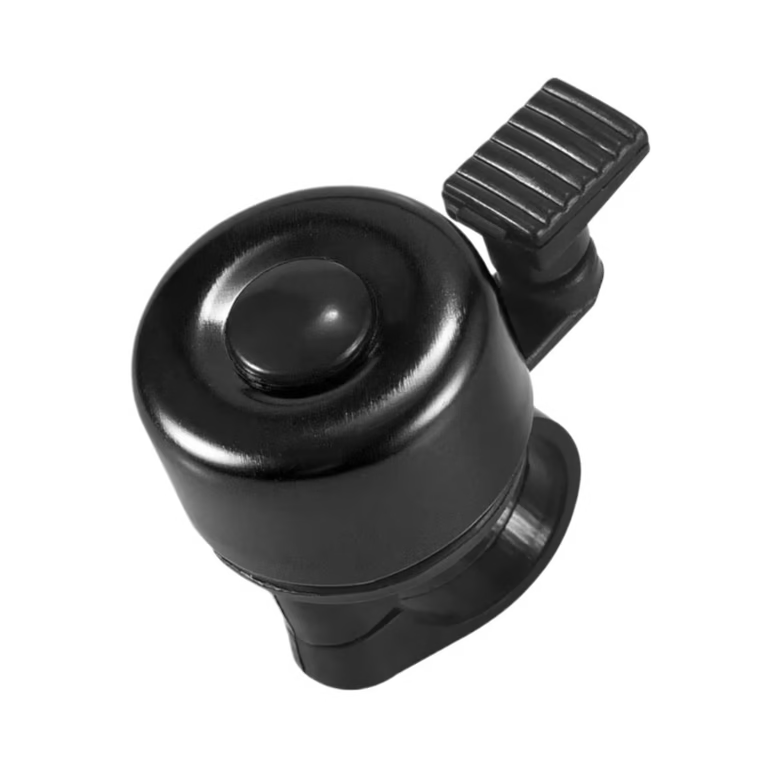
A category buyers often skip because the unit price is low ($2-5 retail), but volume per SKU is very high. A single mid-sized retailer can move 200-500 bells a season. Wholesale MOQ is typically 1,000-2,000 units and pricing is highly competitive — price-per-unit matters more than feature differentiation.
5. Water bottles and bottle cages
Bottles and cages are sold together at the point of sale (the cage is the “anchor” product), but they are sourced separately. Bottles are typically polypropylene or stainless (304 grade for outdoor channels). Cages are aluminum or composite. Both categories run 1,000-3,000 unit MOQ at wholesale.
6. Saddles and saddle cushions
The saddles category has bifurcated: budget gel saddles at $15-30 retail, and ergonomic/cut-out saddles at $35-80 retail. Saddle cushions (overlays) are a separate growing sub-category at $20-50 retail. Spec’ing matters here — the wrong width or padding density produces a 15-25% return rate.
7. Repair and multi-tools
Multi-tools are an evergreen category. The buyer is the home mechanic and the traveler. $15-40 retail covers the bulk of the market. Stocking both a compact 8-10 function tool and a more comprehensive 18-20 function tool covers most demand.
8. Tires and tubes
Tubes are the highest-velocity consumable in cycling. Wholesale MOQ is high (3,000-5,000 units per size) but turn is fast — a tube typically moves in 30-60 days at retail. Tires have longer turn but higher margin. Stock both. Spec by wheel size (700c, 650b, 26″, 27.5″, 29″) and valve type (Presta vs Schrader).
9. Helmets — especially folding and commuter models
Helmets are the category most buyers skip because of certification complexity (CPSC in the US, EN 1078 in Europe). But a folding commuter helmet is one of the fastest-growing sub-categories in 2026, particularly among urban riders and e-bike commuters. Wholesale MOQ is typically 300-500 units and lead time is 60-90 days. Pre-order with the factory 6-8 weeks ahead of season.
10. Saddle bags, handlebar bags, and frame bags
The bikepacking trend has driven this category from niche to mainstream. $20-60 retail covers the bulk. Stocking 2-3 sizes per bag type handles most customer configurations. Wholesale MOQ is typically 500-1,000 units per SKU.
The three categories most buyers quietly skip
These three are commonly missed because they look niche, slow-moving, or under-served in the catalog. In practice, they are higher-margin and lower-competition than the categories above.
Forgot #1: Valve stems and tire accessories
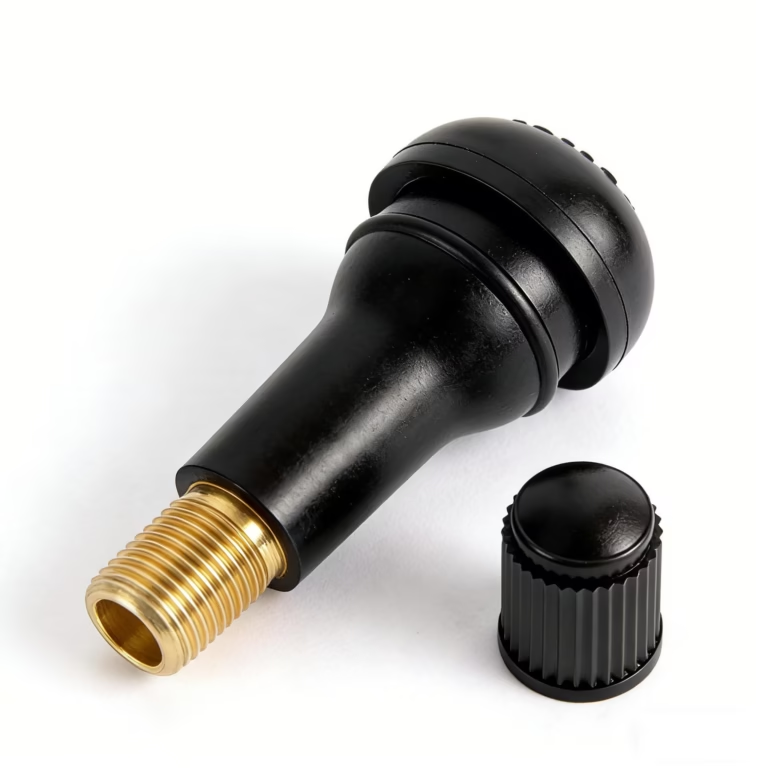
Valve stems are a $1-3 retail consumable that nobody talks about at trade shows. They move in 1,000+ units per month at a busy shop because every tire change needs a new stem. The wholesale margin is high (60-70%) and the SKU count is low (TR413, TR414, Presta). One mid-volume retailer can absorb a full container of valve stems at low risk.
Forgot #2: E-bike specific accessories
E-bike chargers, displays, batteries, and torque arms are an emerging category. The e-bike segment is the only growth pocket inside complete bikes in 2026, and the accessory attach rate per e-bike sold is 2-3x higher than per acoustic bike. Stocking e-bike-specific chargers and display covers alone can capture 5-10% of e-bike buyers.
Forgot #3: Cycling computers and phone mounts
The cycling computer category has shifted from dedicated GPS units to phone mounts. A $15-30 retail phone mount handles 60% of the previous GPS-mount demand. Spec for handlebar diameter (31.8mm and 35mm) and phone size (up to 7-inch display). Wholesale MOQ is 500-1,000 units per SKU and turn is fast.
Bottom line for sourcing teams
The accessories-first catalog is the structural answer to a flat-to-down complete-bike market in 2026. The ten categories above cover the bulk of the demand, and the three “forgot” categories are where smaller retailers can differentiate. Spec carefully on the high-return categories (saddles, helmets, pumps), and price aggressively on the high-volume consumables (valve stems, tubes, bells).
A useful starting point: stock 60-70% of your accessory floor in the “ten categories” above, and 20-30% in the “three forgot” categories. Reserve 10% for regional demand signals (e.g., commuter accessories in metro areas, bikepacking accessories in mountain towns). Two weeks of in-store sell-through data is the fastest way to validate which mix works for your specific market.
About the Author
The AnttifySport Sourcing Team supports wholesale buyers, importers, and brand owners sourcing cycling, hiking, camping, and skiing gear from qualified Asian factories. We’ve worked with over 200 B2B clients across North America, Europe, and Australia since 2018, with a focus on low-MOQ custom orders and OEM/ODM partnerships for emerging outdoor brands.
Have a sourcing question or want to discuss your next product line? Reach out at https://www.anttifysport.com/contact/.
Sources cited in this article
- Fortune Business Insights, June 2026 update of the Bicycle Accessories Market report — used for market size, growth rate, and regional share figures
- NBDA (National Bicycle Dealers Association), 2025 Specialty Bicycle Retailer Survey and Annual Report — used for industry structural data, store closure trends, and brand revenue figures
- PeopleForBikes, 2025 industry trade group reports — used for industry representation figures and DTC trend data
Related Products from AnttifySport
Browse the AnttifySport catalog for outdoor gear covered in this article. All products shown here are part of our wholesale lineup — wholesale pricing, low MOQ, and OEM/ODM support available. Contact our team for quotes.