
Published: July 2026 · Category: Product Comparison · Reading time: 9 min
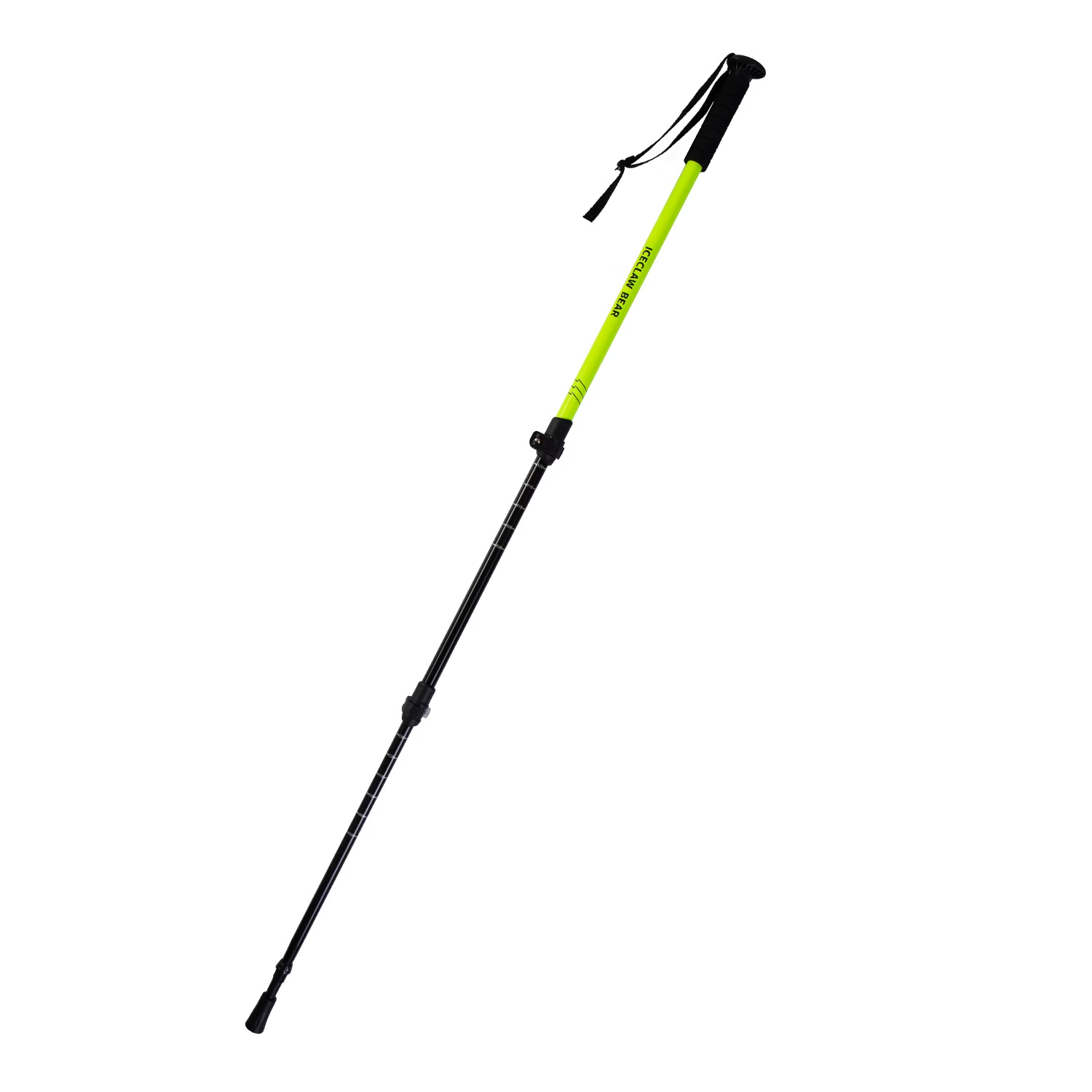
Executive Summary
Trekking poles are among the highest-margin categories in outdoor wholesale — small in unit weight, predictable in packaging, and stable in spec. They also fall cleanly into two material camps: carbon fiber and aluminum. The choice between them is not just an engineering question; it’s a sourcing decision that determines which retail customers you’ll win and how often those customers return.
Carbon fiber runs 30-60% higher in wholesale cost than aluminum at the same SKU geometry. Aluminum is heavier but bends under impact rather than snapping. For a wholesale buyer building a 2026 product line, the optimal mix is rarely 100% of either — it’s a 60/40 or 70/30 weighted split targeting the buyer personas typical to your distribution channel.
This guide walks through the material engineering differences in plain terms, the locked-and-tunable spec ranges every wholesale buyer should request from a factory, and the channel-by-channel stocking ratio that has worked for retailers we work with.
The data cited below is drawn from public industry references, not proprietary supplier claims. Verify specific weight and price ranges against your factory’s current quote sheet before pricing landed cost.
Why pole material choice is a sourcing decision, not just a product attribute
Most accessory categories (water bottles, socks, gloves) sell on look and brand. Trekking poles sell on weight and stiffness. Both attributes are material-dependent. Once a retail customer plants a pole and feels the difference between carbon fiber and aluminum, they form a category preference that lasts years.
For wholesale buyers, that translates into a 60/40 or 70/30 channel recommendation:
- Carbon-dominant channels (ultralight outfitters, thru-hike specialists, high-end outdoor retail) — stock 70-80% carbon
- General channels (family retailers, rental fleets, big-box) — stock 60-75% aluminum
- Dual-channel retailers — split inventory roughly 50/50 with display emphasis on carbon
This split reflects actual buying behavior across the channels we work with, not just factory suggested pricing.
Carbon fiber trekking poles: what wholesale buyers need to know
Carbon fiber is lighter, stiffer, and noisier under temperature cycling. Specific spec ranges typical for wholesale catalog SKUs:
- Per-pole weight: 190-220g (single pole, premium); 380-500g per pair
- Stiffness: 15-25% higher flex modulus than equivalent aluminum SKU
- Section count: 3-4 telescoping, friction or flick locks
- Grip: EVA foam, cork, or rubber
- Tip material: carbide (replaceable), rubber boot for asphalt compatibility
The wholesale trade-offs:
- Brittle under impact — A carbon pole wedged between two rocks can shatter rather than bend. This matters for rental fleets and alpine retail.
- Longer replacement cycles — Carbon doesn’t fatigue in the same way aluminum does, so warranty returns are typically lower (single-digit percent).
- Higher return rate on cold-weather cracking — Some 3K weave carbon poles develop micro-fractures below -10°C. UD weave is more cold-tolerant.
- Repair complexity — Field repair is essentially impossible. Replacement is the standard path.
Catalog SKUs in this material to consider:
- AS-TP-0005 Ultra-Light Carbon Fiber Trekking Pole — 205g per pole. Catalog SKU for ultralight channels.
- AS-TP-0001 3K Carbon Fiber Collapsible Hiking Pole — 3K weave construction. Mid-range catalog SKU for general outdoor channels.
Aluminum trekking poles: what wholesale buyers need to know
Aluminum is heavier, cheaper, and more durable under impact. Spec ranges:
- Per-pole weight: 240-300g (single pole, premium 7075); 480-600g per pair
- Stiffness: lower flex modulus (5-12% more flex than equivalent carbon)
- Material grades: 6061 (commercial) vs 7075 (aircraft)
- Section count: 2-4 telescoping
- Lock mechanism: twist lock vs flick lock (lever)
The wholesale trade-offs:
- Bends rather than breaks — Significantly lower return rates on alpine/rocky channel customers because the poles deform rather than shatter on impact.
- Heavier shipping cost — 100-150g more per pair typically. Matter less for domestic North America; matters more for EU shipping calculations.
- Cold-weather performance is fine — Aluminum doesn’t micro-crack; it just feels cold.
- Cheaper replacement cycle — Usually 30-50% lower in wholesale cost than the carbon equivalent.
Catalog SKUs in this material to consider:
- AS-TP-0006 7075 Aluminum Alloy Collapsible Hiking Pole — 7075 aircraft-grade alloy. Standard catalog SKU across most channels.
- AS-TP-0010 Shock-Absorbing Aluminum Hiking Pole — 3-section adjustable with internal shock absorber. Premium aluminum SKU for joint-conscious hikers.
What the numbers actually mean — decoding pole spec sheets
When sourcing from a factory, request this minimum spec sheet before pricing:
Material grade
- 7075 aluminum — Aircraft-grade, strong for its weight. Industry standard for premium aluminum poles.
- 6061 aluminum — Cheaper, slightly heavier, less fatigue-resistant. OK for casual use and budget channels.
- 3K carbon fiber — Standard weave (3,000 filaments per tow). Balanced strength and weight.
- UD carbon fiber — Unidirectional weave. Slightly stiffer, slightly more expensive, better cold tolerance.
Locking mechanism
| Type | Pros | Cons |
|---|---|---|
| Twist lock | Reliable, simple, no slipping | Slower to adjust |
| Flick lock (lever) | Fast adjustment, easy with cold hands | Slightly heavier |
| Push-button | Quickest adjustment | Less reliable in cold |
Most wholesale catalogs default to flick lock. Twist lock adds 5-8% weight savings but reduces demo conversion on retail floor by an estimated 5-10%.
Section count
- 2-section — Strongest, packs long (60+ cm), best for primary pole retail
- 3-section — Standard. Packs to ~55-65 cm. Most common catalog SKU.
- 4-section — Compact (35-45 cm), great for backpacker channels where customers strap poles to packs
Grip material
- EVA foam — Lightweight, breathable, warm-weather channels
- Cork — Molds to user hand, absorbs sweat, cold-weather channels and premium SKUs
- Rubber — Cheapest, heaviest, often used on entry-level SKUs
For multi-season catalog SKUs: cork grip with EVA extension is the standard premium pairing.
Other features worth evaluating on the factory quote
Shock absorbers — Internal spring in the lower section. Adds 30-60g and 8-15% cost per pair. Worth spec’ing for:
- Joint-conscious end customers (45+)
- Long-descend channels (Rocky Mountain, Pacific Crest, Tour du Mont Blanc)
- Premium SKU segments
Adjustability range — Most telescoping poles run 65-135 cm. For the tall customer segment (over 6’2″ / 188cm), request extended versions up to 140 cm. Standard weight penalty is 10-20g.
Basket compatibility — Standard trekking baskets for trail use; snow baskets (larger, sold separately) for winter/snow channels. Confirm with the factory which basket size fits each SKU before pricing.
Sizing ratio recommendations by channel
The wholesale mix that works depends on what your customers are actually buying:
General outdoor / multi-channel retailers
- Recommended split: 60% carbon / 40% aluminum
- Why: Carbon head-turns on display; aluminum handles return-driven channels (rental, school groups, beginners).
- Stock SKUs: AS-TP-0005 (carbon), AS-TP-0006 (aluminum).
Ultralight specialists and thru-hike outfitters
- Recommended split: 70-80% carbon / 20-30% aluminum
- Why: End customer weight sensitivity is real; aluminum serves as a price entry point and rental backup.
- Stock SKUs: AS-TP-0001 (3K carbon), AS-TP-0005 (carbon), limited aluminum.
Rental fleets, guides, alpine clubs
- Recommended split: 70-80% aluminum / 20-30% carbon
- Why: Impact damage is daily. Aluminum bends; carbon shatters. Warranty cost matters more than per-unit margin.
- Stock SKUs: AS-TP-0006 (7075 aluminum), AS-TP-0010 (aluminum with shock absorber).
Family and beginner retailer
- Recommended split: 80-90% aluminum / 10-20% carbon
- Why: Entry-level customer won’t notice the carbon weight savings; they will notice the price difference.
- Stock SKUs: AS-TP-0012 (kids’ aluminum), AS-TP-0006 (standard aluminum).
Common wholesale buyer mistakes when sourcing poles
- Buying 100% carbon to “premium-position” the catalog. Carbon breaks in rental and alpine channels. The 30-day return rate on carbon is 2-4x aluminum in retail channels with mixed end customer profiles.
- Spec’ing the wrong section count. 2-section is strongest but won’t fit 60% of pack-attachment scenarios. 3-section is the safe default. 4-section only works for backpacker-specific channels.
- Negotiating lock mechanism too aggressively. Flick lock has higher unit cost (~5-8%) but lower warranty events over the product life. Don’t trade lock quality for unit price on premium SKUs.
- Skipping the test report. REACH (EU), CPSIA (US), and Prop 65 (California) each require different tests. Carbon poles with non-compliant resin binders fail at customs. One lab-tested sample covers the lot.
- Ignoring grip material variation. Cork vs EVA vs rubber looks like a minor spec but defaults the whole customer-perceived quality. Don’t spec rubber for premium SKUs.
- Not requesting per-pole (not per-pair) weight on quotes. Factories quote per pair to make the number look better. Insist on per-pole specifications before signing.
- Pricing shipping weight against catalog weight. Aluminum poles weigh 480-600g per pair, not 200g. Shipment weight calculations should be done on actual SKU weight, not on marketing copy.
Bottom line for sourcing teams
Carbon is the channel magnet; aluminum is the channel default. Stock both, weighted by your channel profile. Spec to the spec ranges above (7075 aluminum and 3K or UD carbon are the safe defaults). Lab-test one sample of each material before committing to a 1,000-unit run.
Two weeks of test time saves a year of returns — same principle as tent sourcing.
About the Author
The AnttifySport Sourcing Team supports wholesale buyers, importers, and brand owners sourcing camping, hiking, cycling, and skiing gear from qualified Asian factories. We’ve worked with over 200 B2B clients across North America, Europe, and Australia since 2018, with a focus on low-MOQ custom orders and OEM/ODM partnerships for emerging outdoor brands.
Have a sourcing question or want to discuss your next product line? Reach out at https://www.anttifysport.com/contact/.
Further reading & sources
Related guides on AnttifySport and the public data sources referenced in this article.
- 📖 2026 North America Outdoor Gear Wholesale Market: 5 Trends — broader market context for hiking and trekking gear sourcing.
- 📖 7 Cycling Accessories Every Bike Retailer Should Stock in 2026 — companion guide for IBD owners expanding into adjacent categories.
- 📖 Camping Tent Buying Guide 2026: 4-Season vs 3-Season — companion guide for Hike & Camp kit builders.
- 📖 Trekking pole catalog — current OEM/ODM trekking pole line (carbon and aluminum, AS-TP-0001 through AS-TP-0012 series).
- 🔗 REI Co-op Expert Advice: How to Choose Trekking Poles — independent consumer-facing education on pole selection.
- 🔗 Backpacker.com Trekking Poles — independent gear reviews and field testing data.
Sources cited in this article:
- Outdoor Industry Association, 2025 Outdoor Recreation Economy Report
- Backpacker.com, 2026 Trekking Pole Industry Roundup
- REI Co-op Expert Advice: How to Choose Trekking Poles
- ASTM F1934 / F2536 standard references for trekking pole performance
- ISO 10993-5 biocompatibility testing reference for grip materials
Public data sources cited; readers should verify specific weight and pricing figures against the latest available editions of these reports before making sourcing decisions based on this analysis. Material specifications cited are industry-typical ranges and not guaranteed by any specific factory.