Published: 2026 · Category: B2B Buying Guide · Reading time: 8 min
Executive Summary
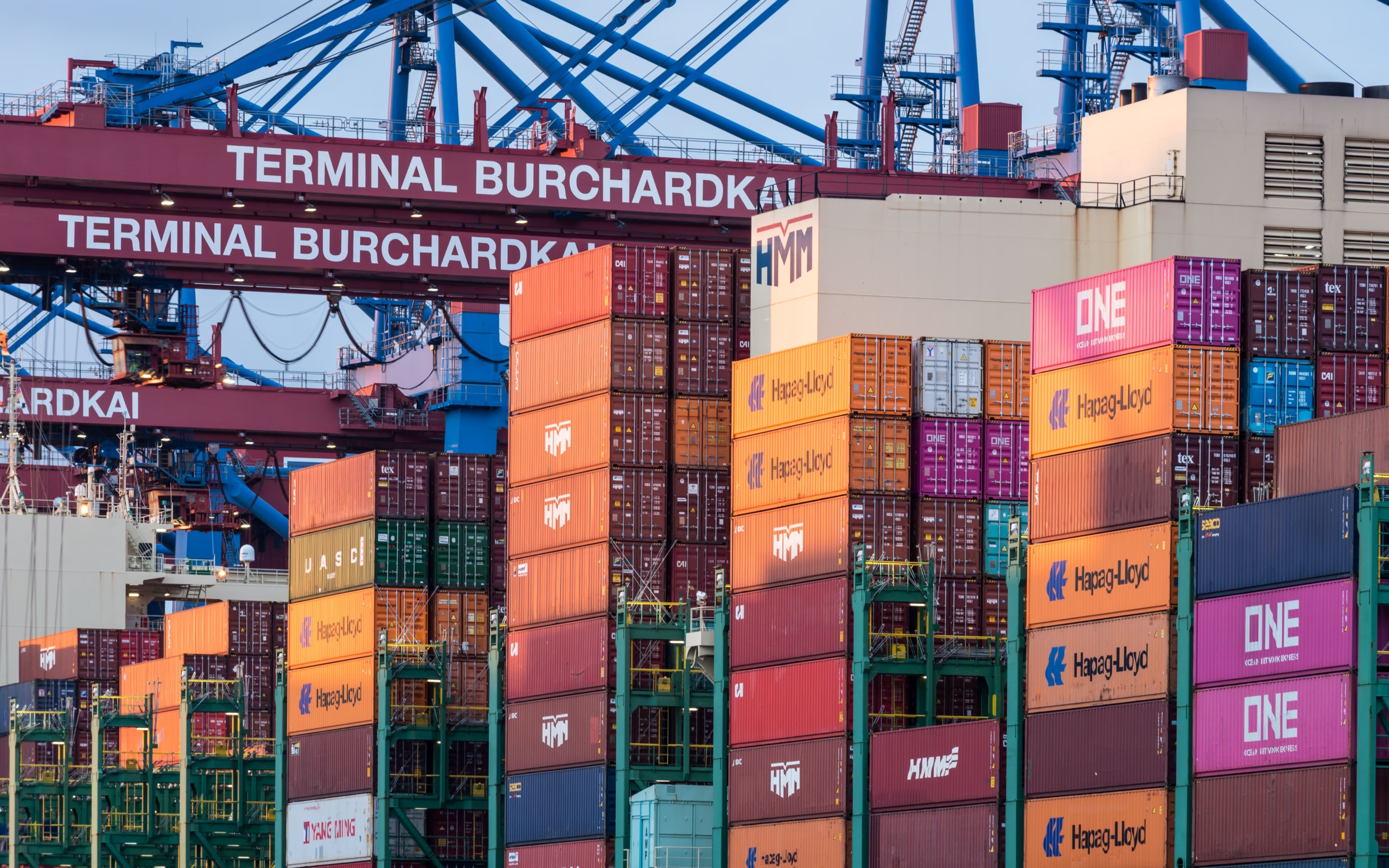
Container consolidation is the single largest cost lever in outdoor gear sourcing. A 40-foot HQ container that costs $3,000-6,000 in ocean freight has roughly 60 cubic meters of usable volume, which is enough to fit 3,000-8,000 unit pairs of typical outdoor gear depending on size and packaging. Whether the buyer fills that container with one factory’s product or consolidates from multiple factories changes the per-unit landed cost by 20-40%.
This guide covers the four consolidation strategies available to wholesale buyers, the volume thresholds that justify each strategy, the documentation and quality control overhead each adds, and the supplier-management complexity each introduces. The framework applies whether you are sourcing for retail, building a private label program, or advising end customers on import logistics.
The figures cited are drawn from public industry references and AnttifySport’s catalog spec sheets. Verify specific container capacity, freight rates, and supplier terms against your forwarder’s current rate sheet before finalizing logistics decisions.
Why consolidation strategy matters more than per-unit price
Most wholesale buyers ask the wrong first question. They focus on per-unit FOB price. FOB price matters for unit economics, but the dominant variable for total landed cost is how efficiently the buyer fills containers and consolidates supplier shipments. The four consolidation variables that drive 80% of total-cost decisions are:
- Container utilization rate — the percentage of usable container volume filled; less than 80% indicates inefficient consolidation
- Number of supplier factories — each additional supplier adds documentation and quality control overhead
- Production-to-shipment lead time — the time between final production and port loading; longer lead times require more warehousing
- Documentation complexity — the number of customs documents per shipment; consolidation reduces total document count
For wholesale buyers, this means: a $0.50 lower per-unit price from a smaller factory often produces a $2-3 higher per-unit landed cost after consolidation inefficiencies. The factory with the best unit price is rarely the lowest total-cost option.
The four consolidation strategies
The four strategies below cover roughly 95% of B2B outdoor gear consolidation scenarios. Each has different volume thresholds, cost implications, and complexity profiles.
Strategy 1: Single-factory full-container
How it works:
- Single supplier produces the entire order — one factory, one purchase order, one container
- Simplest documentation — single commercial invoice, packing list, and bill of lading
- Lowest freight cost per unit — full-container rates are typically 30-50% lower than LCL (less than container load)
- Lowest complexity — no coordination between suppliers; one quality control inspection covers the entire order
When to use:
- Single product category — when all products come from the same supplier specialization
- High-volume single SKU — when one SKU fills most of the container
- Established supplier relationship — when the buyer has a trusted factory partner
Volume threshold: 3,000-8,000 unit pairs depending on product size, or full container utilization at the factory’s minimum production run.
Strategy 2: Multi-factory full-container
How it works:
- Multiple suppliers each produce a portion of the order — separate purchase orders, consolidated into one container
- Consolidation warehouse — buyer’s warehouse or third-party consolidation facility receives from each factory, then loads the container
- More complex documentation — multiple invoices consolidated under one master commercial invoice
- Higher freight cost per unit than single-factory — but better per-unit pricing through supplier competition
When to use:
- Multiple product categories — when different categories come from different factory specializations
- Mid-volume per category — when no single category fills a container
- Need for supplier competition — when the buyer wants to maintain pricing pressure
Volume threshold: 5,000-15,000 total units across categories, with no single category below 1,000 units.
Strategy 3: LCL (less than container load)
How it works:
- Order does not fill a full container — shipped as partial container, sharing space with other buyers
- Freight forwarder handles consolidation — the forwarder combines shipments from multiple buyers into containers
- Highest per-unit freight cost — typically 50-100% higher per cubic meter than full-container rates
- Longer transit time — LCL shipments wait for container consolidation, adding 7-14 days
When to use:
- Low-volume trial orders — when the buyer is testing a new product or supplier
- Sample-to-production transition — when the initial production run is below container capacity
- Cash flow constraints — when the buyer cannot afford the working capital for full-container orders
Volume threshold: 100-3,000 units depending on product size; freight cost per unit typically 2-4x higher than full-container.
Strategy 4: Mixed consolidation with shared buyers
How it works:
- Multiple buyers share a container — typically arranged by a sourcing agent or buying group
- Lower per-unit freight cost than LCL — but more coordination overhead
- Shared customs clearance — one customs entry covers all buyers; each buyer receives their consolidated shipment at destination
- Trust requirement — the buying group or agent must be reliable to handle shared documentation
When to use:
- Small buyer networks — when several small buyers together fill a container
- Industry trade associations — when an association arranges group purchases for members
- Sourcing agent relationships — when the buyer has a trusted agent with other client orders
Volume threshold: 500-3,000 units per buyer; container shared by 2-5 buyers.
Documentation requirements by strategy
The documentation complexity varies by strategy. The table below summarizes the key documents:
- Single-factory full-container: 1 commercial invoice, 1 packing list, 1 bill of lading, 1 certificate of origin, 1 product compliance documentation set
- Multi-factory full-container: 2-5 factory invoices, 1 consolidated commercial invoice, 1 packing list per factory, 1 bill of lading, 1 master certificate of origin with sub-certificates per factory
- LCL: 1 commercial invoice, 1 packing list, freight forwarder’s house bill of lading (instead of master bill), consolidated customs clearance
- Shared buyer consolidation: 1 commercial invoice per buyer, consolidated customs entry, individual delivery at destination
Common mistakes when consolidating outdoor gear
Three patterns show up repeatedly in B2B consolidation conversations:
- Filling the container too early — adding a low-quality supplier just to fill volume; quality issues cost more than freight savings
- Ignoring packaging dimensions — assuming all products pack the same way; oversized packaging reduces utilization 20-40%
- Skipping pre-shipment inspection for consolidated orders — inspecting each factory’s output separately is more thorough than inspecting the consolidated container
Spec callouts by product category
Beyond the three common mistakes, three product-category-specific callouts are worth flagging:
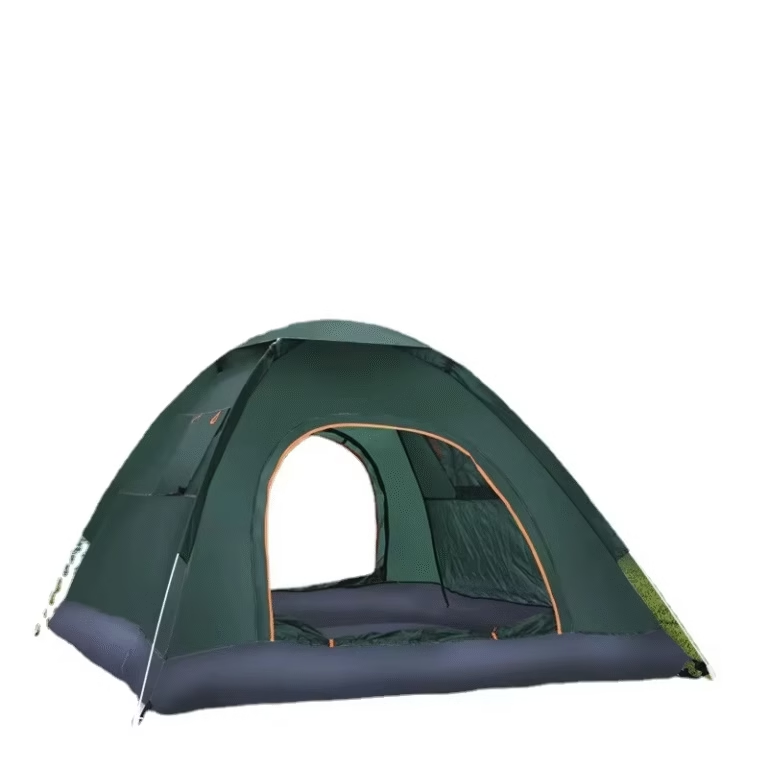
- Camping tents: bulky volume even when folded; require master carton optimization to fill containers
- Hard goods (poles, helmets): rigid shapes limit stacking efficiency; require careful carton design
- Soft goods (socks, apparel): compress well; typically fill containers at the highest utilization rate (90%+)
Volume thresholds for consolidation strategy selection
The volume threshold to select each consolidation strategy differs by category:
- Single-factory full-container: 5,000+ units total is the typical threshold
- Multi-factory full-container: 3,000-5,000 units across 2-3 factories is sufficient
- LCL: 500-3,000 units is the typical threshold
- Shared buyer consolidation: 1,000-3,000 units is the typical threshold
For more detailed sourcing guidance on supplier selection, see our wholesale outdoor gear process page.
Bottom line for sourcing teams
The four consolidation strategies (single-factory full-container, multi-factory full-container, LCL, shared buyer consolidation) each suit different volume profiles and product categories. Single-factory full-container produces the lowest per-unit landed cost when volume is high; LCL provides flexibility when volume is low.
Spec the container utilization rate to 80%+ for cost efficiency, and plan for pre-shipment inspection at each factory before consolidation. Budget 5-10% of total product cost for documentation, quality control, and consolidation overhead. Two weeks of consolidation planning saves months of downstream logistics issues.
About the Author
The AnttifySport Sourcing Team supports wholesale buyers, importers, and brand owners sourcing camping, hiking, cycling, and skiing gear from qualified factories. We’ve worked with over 200 B2B clients across North America, Europe, and Australia since 2018, with a focus on low-MOQ custom orders and OEM/ODM partnerships for emerging outdoor brands.
Have a sourcing question or want to discuss your next product line? Reach out at https://www.anttifysport.com/contact/.
Further reading & sources
Related guides on AnttifySport and the public data sources referenced in this article.
- 📖 How to Vet Chinese Outdoor Gear Suppliers — companion supplier selection guide.
- 📖 OEM / ODM services catalog — current AnttifySport factory partnership model.
- 📖 2026 North America Outdoor Gear Wholesale Market: 5 Trends — broader market context.
- 📖 How to Choose Hiking Socks for Different Climates — companion product guide.
- 📖 Camping Tent Buying Guide 2026: 4-Season vs 3-Season — companion product guide.
- 🔗 FIDI Global Alliance — international federation of freight forwarders.
- 🔗 International Air Transport Association — air freight and logistics standards.
Sources cited in this article:
- International Chamber of Shipping container specifications
- World Bank Trade Logistics Performance Index
- International Trade Centre (ITC) SME trade facilitation guides
- U.S. Commercial Service export documentation handbooks
- European Commission customs and trade facilitation resources
Public data sources cited; readers should verify specific container capacity, freight rates, and documentation requirements against your forwarder’s current rate sheet and latest editions of these references before committing to logistics decisions. Cost ranges cited are industry-typical and not guaranteed for any specific shipment.
Related Products from AnttifySport
Browse the AnttifySport catalog for outdoor gear covered in this article. All products shown here are part of our wholesale lineup — wholesale pricing, low MOQ, and OEM/ODM support available. Contact our team for quotes.