Published: 2026 · Category: B2B Buying Guide · Reading time: 10 min
Executive Summary
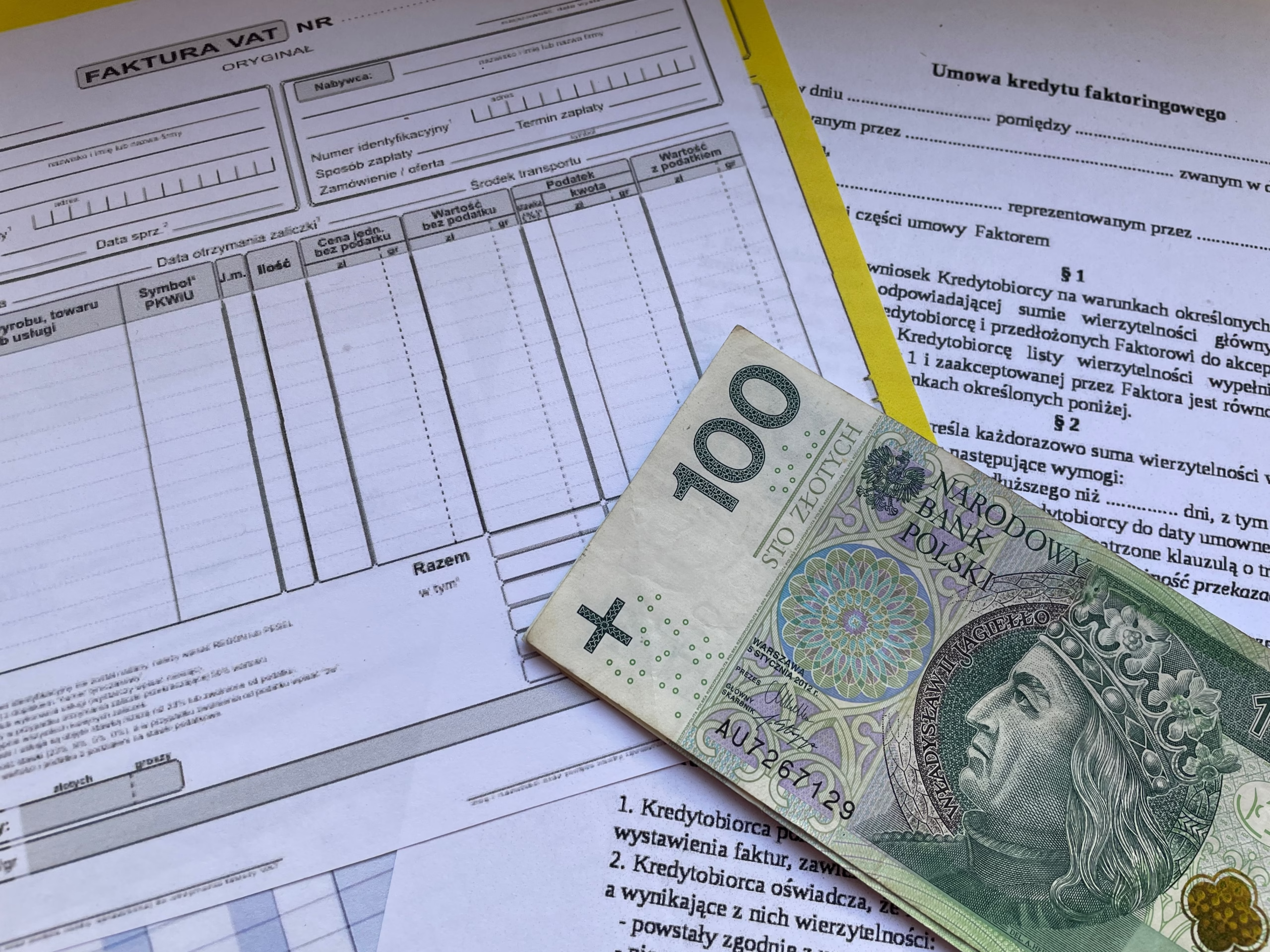
Payment terms are the second-largest cost lever in outdoor gear sourcing after unit price, and the most common source of cash-flow stress for first-time importers. Three payment structures dominate B2B outdoor gear transactions: T/T (telegraphic transfer), L/C (letter of credit), and Open Account (net-30/60/90). Each structure allocates risk differently between buyer and supplier, with corresponding cost and complexity tradeoffs.
This guide covers the three payment structures, the volume and trust thresholds that justify each, the documentation required for each, the negotiation tactics that improve terms over time, and the common currency and exchange-rate considerations that affect T/T and L/C transactions with Chinese suppliers. The framework applies whether you are sourcing for retail, building a private label program, or advising end customers on import financing.
The figures cited are drawn from public industry references and AnttifySport’s catalog spec sheets. Verify specific bank fees, exchange rates, and supplier terms against your bank’s current rate sheet before finalizing payment decisions.
Why payment structure matters more than unit price
Most wholesale buyers ask the wrong first question. They focus on per-unit FOB price. FOB price matters for unit economics, but the dominant variable for cash flow and risk is the payment structure. The four payment variables that drive 80% of cash-flow decisions are:
- Cash flow timing — the gap between paying the supplier and receiving goods; 30-90 days for open account, 0-30 days for T/T, 0 days for L/C issuance
- Risk allocation — who bears the risk if goods are lost, damaged, or not delivered; supplier, buyer, or shared via bank
- Documentation overhead — the paperwork required for each payment structure; L/C requires the most
- Bank fees and exchange rate exposure — typically 0.5-3% of transaction value, varying by structure
For wholesale buyers, this means: a $0.50 lower per-unit price from a supplier demanding 100% upfront T/T is often a worse deal than paying 5% more for net-60 open account. Payment terms directly affect working capital, which is the binding constraint for most growing wholesalers.
The three payment structures
The three structures below cover roughly 95% of B2B outdoor gear payment scenarios. Each has different cash flow, risk, and complexity profiles. The structure that is right for a given order depends on the buyer’s relationship with the supplier, the order value, the buyer’s available working capital, and the buyer’s tolerance for documentation overhead.
First-time importers often default to T/T 30/70 because it is the simplest and most familiar structure. However, this default can leave the buyer exposed to risk or, conversely, can lead to overpayment of premium for protection that is not needed. Matching the payment structure to the specific situation — rather than applying the same terms to every order — is the difference between an efficient supply chain and a costly one.
Structure 1: T/T (telegraphic transfer)
How it works:
- Buyer wires funds directly to supplier’s bank account — typically in USD or CNY
- Common split: 30% deposit + 70% balance — the deposit secures production; the balance is paid before shipment
- Lowest documentation overhead — bank wire receipt is the only confirmation
- Supplier carries production risk — once the deposit is paid, supplier begins production with no further protection
When to use:
- Established supplier relationships — when buyer has 3+ orders with the same supplier
- Cash-constrained supplier — when the factory needs upfront cash for material purchase
- Small-to-medium orders — when L/C fees would not be justified by order size
Risk profile: Highest buyer risk (funds committed before shipment); lowest supplier risk (payment guaranteed).
Structure 2: L/C (letter of credit)
How it works:
- Buyer’s bank guarantees payment — upon presentation of documents matching the L/C terms
- Documents include bill of lading, commercial invoice, packing list, certificate of origin — and any product-specific documents required by the L/C
- Supplier receives payment from the bank — after presenting conforming documents; bank then collects from buyer
- Bank charges 0.5-2% of L/C value — for issuance and document handling
When to use:
- Large order values — typically $50,000+ where the bank’s protection justifies the fees
- New supplier relationships — when buyer has no track record with the supplier
- High-risk destinations or categories — when political or commercial risk is elevated
Risk profile: Lowest buyer risk (payment only on conforming documents); lowest supplier risk (bank guarantee).
Structure 3: Open account (net-30/60/90)
How it works:
- Buyer receives goods first, pays later — at net-30, net-60, or net-90 from invoice date
- Supplier carries the financing cost — either through their own capital or supplier financing
- Lowest documentation overhead — invoice is the primary document
- Requires trust and trade credit history — only available to buyers with established credit
When to use:
- Mature supplier relationships — typically 6+ orders over 12+ months
- Strong buyer’s credit profile — established business with verifiable financial history
- Cash flow optimization — when buyer needs to sell goods before paying supplier
Risk profile: Highest supplier risk (goods shipped before payment); lowest buyer risk (payment after goods received).
Documentation requirements by structure
The documentation complexity varies by structure:
- T/T: Purchase order, proforma invoice, bank wire receipt; minimal additional documentation
- L/C: L/C application, L/C terms document, bill of lading, commercial invoice, packing list, certificate of origin, insurance certificate, product compliance documents as specified in L/C
- Open account: Purchase order, invoice, shipping documents; minimal additional documentation
Currency and exchange-rate considerations
Two currency considerations affect all three payment structures when sourcing from Chinese suppliers:
- USD vs CNY invoicing: Most Chinese factories prefer USD invoicing for international buyers; some factories offer CNY pricing with a 1-2% discount
- Forward contracts for large orders: For orders over $50,000 USD, consider locking the exchange rate with a 3-6 month forward contract to eliminate currency risk
For wholesale buyers, this means: a $50,000 order paid in USD with a 1% currency swing can produce a $500 cost variance unrelated to the actual product. Forward contracts or natural hedges (matching payment currency to sales currency) reduce this risk.
Common mistakes when structuring outdoor gear payments
Three patterns show up repeatedly in B2B payment conversations:
- Accepting 100% upfront T/T for new suppliers — exposes buyer to full risk with no track record
- Skipping L/C for large first-time orders — saves on fees but loses bank protection
- Negotiating net terms without demonstrating credit — suppliers rarely grant open account without proof
Spec callouts by order size
Beyond the three common mistakes, three order-size-specific callouts are worth flagging:
- Under $10,000 orders: T/T with 30/70 split is standard; L/C fees are typically not justified
- $10,000-50,000 orders: T/T with 30/70 split or L/C at 100% — depends on buyer-supplier relationship
- Over $50,000 orders: L/C at 100% is the standard; T/T may be negotiated with significant discount
Negotiation tactics for better terms
The volume threshold to negotiate better terms differs by strategy:
- First order: T/T 30/70 is typical; L/C if buyer wants bank protection
- Second to fifth order: T/T 30/70 may transition to T/T 20/80 or 10/90 with relationship growth
- After 5+ orders: Open account net-30 or net-60 may become available; requires credit demonstration
For more detailed sourcing guidance on supplier selection, see our wholesale outdoor gear process page.
Bottom line for sourcing teams
The three payment structures (T/T, L/C, open account) each suit different relationship stages and order sizes. T/T 30/70 is the standard starting point; L/C provides protection for large first-time orders; open account becomes available with established relationship history.
Spec the bank fees, documentation requirements, and risk allocation to match the order value and relationship stage. Plan for a 12-18 month progression from T/T to open account as supplier relationship matures. Use USD invoicing for predictability and consider forward contracts for orders over $50,000. Two months of payment negotiation saves six months of cash-flow stress.
About the Author
The AnttifySport Sourcing Team supports wholesale buyers, importers, and brand owners sourcing camping, hiking, cycling, and skiing gear from qualified factories. We’ve worked with over 200 B2B clients across North America, Europe, and Australia since 2018, with a focus on low-MOQ custom orders and OEM/ODM partnerships for emerging outdoor brands.
Have a sourcing question or want to discuss your next product line? Reach out at https://www.anttifysport.com/contact/.
Further reading & sources
Related guides on AnttifySport and the public data sources referenced in this article.
- 📖 How to Vet Chinese Outdoor Gear Suppliers — companion supplier selection guide.
- 📖 Container Consolidation Strategies for Outdoor Gear — companion logistics guide.
- 📖 OEM / ODM services catalog — current AnttifySport factory partnership model.
- 📖 2026 North America Outdoor Gear Wholesale Market: 5 Trends — broader market context.
- 📖 How to Choose Hiking Socks for Different Climates — companion product guide.
- 🔗 International Chamber of Commerce (ICC) — Incoterms and UCP 600 (L/C rules).
- 🔗 U.S. Commercial Service Trade Finance Guide — independent trade finance resources.
Sources cited in this article:
- ICC Uniform Customs and Practice for Documentary Credits (UCP 600)
- ICC Incoterms 2020
- SWIFT MT103 message standards for T/T payments
- International Trade Centre (ITC) trade finance guides
- U.S. Commercial Service export financing documentation
Public data sources cited; readers should verify specific bank fees, exchange rates, and supplier terms against your bank’s current rate sheet and latest editions of these references before committing to payment decisions. Cost ranges cited are industry-typical and not guaranteed for any specific transaction.
Related Products from AnttifySport
Browse the AnttifySport catalog for outdoor gear covered in this article. All products shown here are part of our wholesale lineup — wholesale pricing, low MOQ, and OEM/ODM support available. Contact our team for quotes.