Published: July 2026 · Category: Outdoor How-To · Reading time: 10 min Water bottle wholesale sourcing buyers and retailers—this guide covers what you need to know.
Executive Summary
Water bottles look like a commodity category. Three materials (stainless steel, plastic, glass), many shapes, low unit weight — what could be confusing?
Quite a lot, actually. The water bottle category is the highest-volume, lowest-margin SKU in outdoor wholesale. Wholesale margins typically run 35-50% on stainless and 25-40% on plastic. Order volume of 5,000-50,000 per SKU is common. Small per-unit spec differences compound across thousands of units — a 50g weight difference or a 5% defect rate change can swing a buyer’s landed cost by 8-12% on a 10,000-unit run.
This guide covers the three material decisions every wholesale buyer needs to make: stainless steel grade choice (304 vs 316), single-wall vs double-wall vacuum, and the materials that don’t fit outdoor channels (glass + aluminum with internal coating). The channel-split recommendation at the end gives a starting point for retailers building a 2026 SKU line.
The figures cited are drawn from public industry references and AnttifySport’s catalog spec sheets. Verify specific weight and price figures against your factory’s current quote sheet before pricing landed cost.
Why water bottles matter more than they look in a B2B catalog
Water bottles are volume anchors. They move in cases of 24, sell at $12-30 retail, and are bought by every outdoor retailer from the smallest fly-shop to REI. As a wholesale SKU they have three properties worth understanding:
- Low perception price, high actual order size. A $20 retail bottle moving 2,000 units per quarter at a mid-sized retailer is a $40,000 quarterly revenue line for that retailer — bigger than most carbon-pole SKUs.
- Highest repeat customer penetration of any outdoor category. A buyer who likes their bottle will replace it every 3-5 years, not every year. That repeat economics is what makes water bottles viable at category-low margins.
- Highest return rate on aluminum + glass. Both materials break in transit and at retail. Stainless is the only true category mainstay for outdoor channels.
For wholesale buyers, that means: a 5,000-10,000 unit annual run is not unusual in this category, and the wrong material choice produces a 3-5% return rate compounding into significant warranty cost.
The three-material breakdown for wholesale sourcing
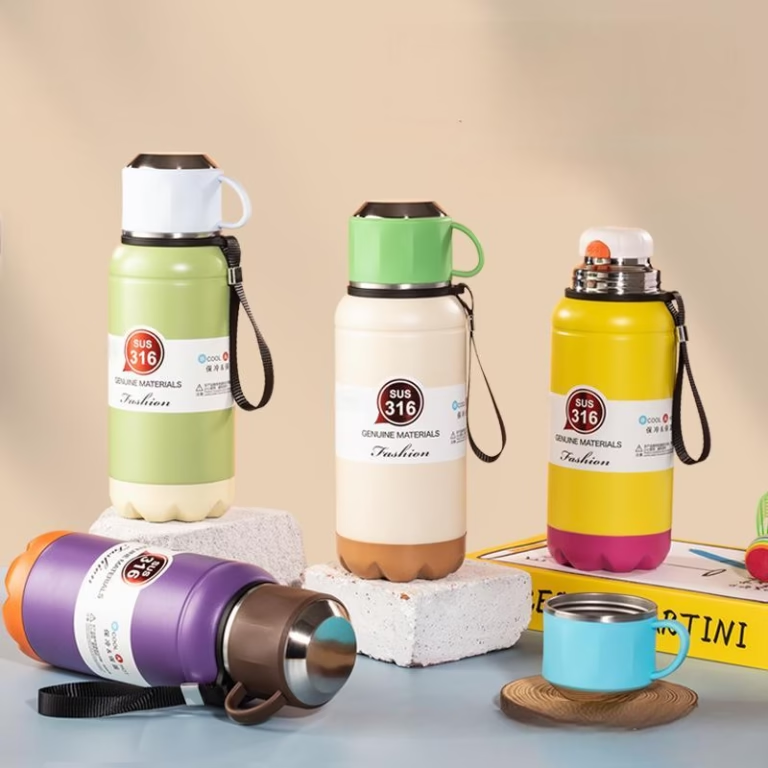
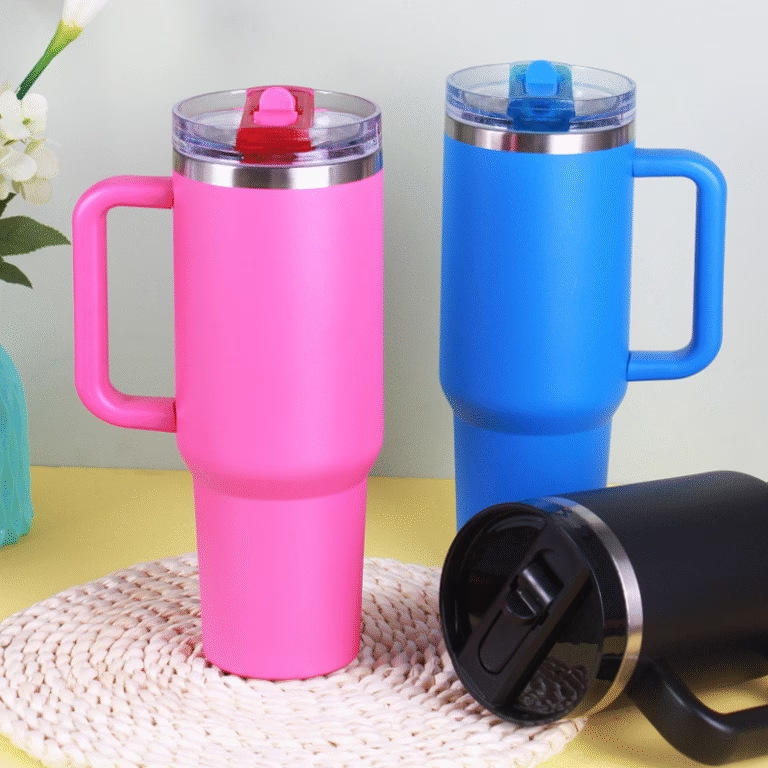
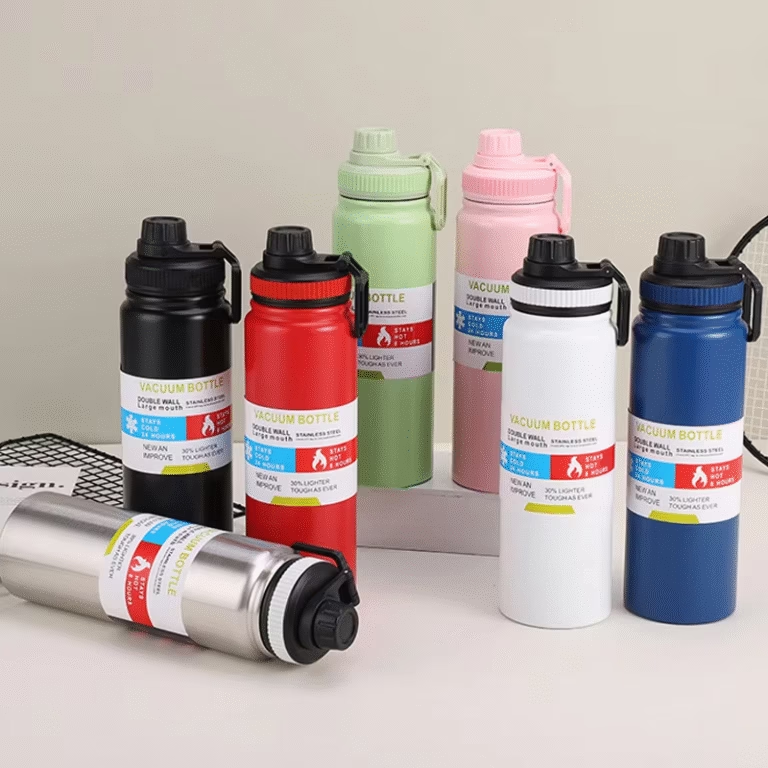
Stainless steel
Stainless dominates outdoor channels at 60-80% of typical SKU mix. Spec ranges typical for wholesale catalog SKUs:
- Per-unit weight: 280-400g (single-wall 500ml); 380-550g (double-wall vacuum 500ml)
- Wall construction: single-wall (no insulation) vs double-wall vacuum (12-24 hour cold retention)
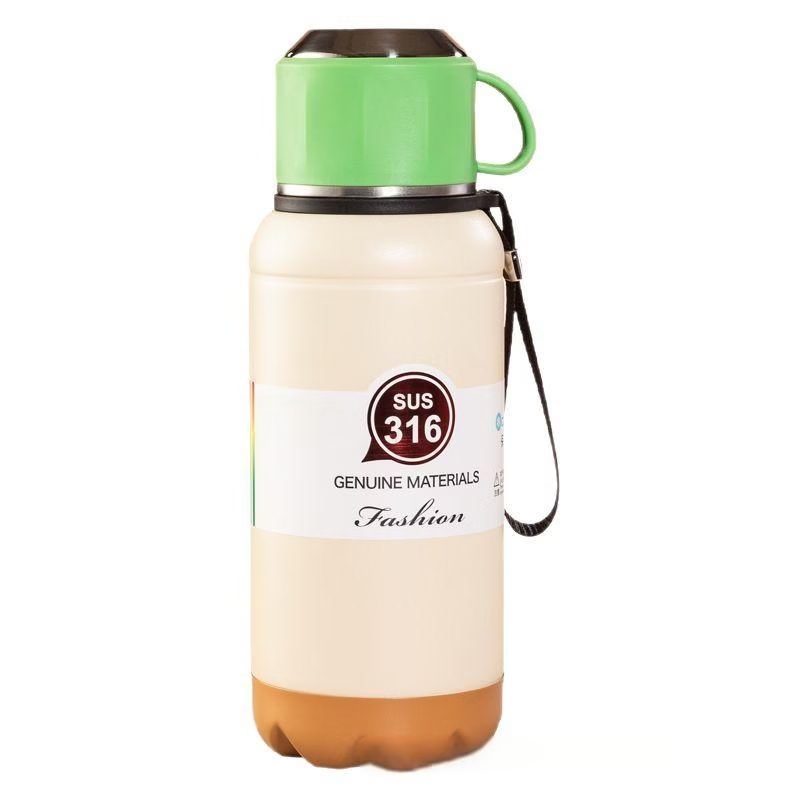
- Steel grade: 304 (18/8) standard vs 316 (with 2-3% molybdenum, marine-grade)
- Cap types: screw-on, flip-top, straw-top, sports cap
- Capacity range: 350ml to 2,000ml catalog SKUs
- Lid material: PP plastic (standard) or 18/8 stainless (premium)
The wholesale trade-offs:
- Landed cost $3-7 per unit for 304 stainless double-wall, $4-9 for 316 grade
- Customization options: lid color, capacity marking, custom logo printing (silk-screen, laser engraving)
- OEM private label programs are widely available — minimum orders typically 500-1,000 units per SKU per color
- Hardest material to dent in transit — most wholesale operations have a <1% damage-in-transit rate on stainless bottles
- Most channel-flexible material — works in outdoor retail, corporate gifts, fitness, school, travel
Plastic (BPA-free Tritan or copolyester)
Plastic captures 15-25% of typical outdoor SKU mix. Spec ranges typical for wholesale catalog SKUs:
- Per-unit weight: 100-180g (500ml)
- Common materials: Tritan (clear), copolyester (clear or colored), HDPE (opaque)
- Wall construction: single-wall only (no insulation possible at retail cost)
- Capacity range: 350ml to 1,000ml catalog SKUs
- Cap types: squeeze-top, pull-top, screw-top
The wholesale trade-offs:
- Landed cost $1.50-3.50 per unit — usually 50-60% cheaper than stainless
- Customization options: cap color, capacity marking, custom logo printing (silk-screen and pad printing)
- Quickest OEM turnaround — most factories produce plastic bottles in 30-45 days vs 45-60 for stainless
- Shortest retail shelf life — Tritan yellows and cracks after 2-3 years; constant replacement purchases
- Higher damage-in-transit rate — plastic cracks at extreme cold; higher reject rate on FTL shipping in winter
Glass
Glass occupies <5% of typical outdoor SKU mix in North America. Spec ranges typical for wholesale catalog SKUs:
- Per-unit weight: 350-500g (500ml) — heavier than stainless
- Wall construction: single-wall or double-wall (with silicone sleeve)
- Common materials: borosilicate (heat-resistant) vs soda-lime (standard)
- Capacity range: 350ml to 1,000ml catalog SKUs
- Cap types: screw-on with silicone seal
The wholesale trade-offs:
- Landed cost $2.50-5 per unit — only slightly cheaper than stainless
- Customization options: cap color, sleeve color, custom logo on sleeve
- Worst damage-in-transit rate — glass breaks in nearly every unboxing. Most factories quote a 3-5% loss rate on shipped glass
- Highest carbon-footprint per unit shipping weight — heavier than stainless
- Limited retail channels — desk/office use primarily; outdoor retail stocking is rare
Aluminum (with internal coating)
Aluminum with epoxy liner is a fourth option often quoted by factories. Spec ranges:
- Per-unit weight: 200-300g (500ml) — lightest of the four
- Wall construction: single-wall only
- Internal coating: epoxy or BPA-free liner (required)
- Cost: $2-4 landed
The wholesale trade-offs:
- Internal coating degrades over time — most aluminum bottles have a 3-5 year usable life before the coating fails and exposes aluminum substrate
- BPA-free coating certification — must be verified per SKU; non-certified liners are common in cheaper samples
- Lower return rate than glass, higher than stainless
- Limited retail channels outside of hiking/budget — niche use cases
Spec ranges to request from the factory
When getting a factory quote, request this minimum spec sheet per SKU before pricing:
Material specification
- Stainless grade (304 or 316)
- Plastic material trade name (Tritan TX1001 vs generic copolyester)
- Wall thickness (mm)
- Vacuum retention time (hours cold and hours hot for double-wall)
Capacity and dimensions
- Volume (ml) at fill
- Height (mm)
- Diameter (mm) at widest point and at base
- Net weight (g) excluding cap
Lid and cap
- Lid material
- Thread type
- Whether cap is replaceable / dishwasher-safe
- Spout diameter (mm) for straw-cap SKUs
Finish and printing
- Powder coating color (for colored SKUs)
- Whether stainless unpainted interior is visible
- Printing options (silk-screen pad count, laser engraving max area, full-wrap vs single-side)
Compliance references
- FDA food contact certification
- LFGB certification (EU equivalent)
- California Prop 65 statement
- REACH (EU) statement
Most factories will quote a spec sheet only on request. Spec-grade SKUs without an attached spec sheet are typically consumer-grade SKUs that have not been independently tested; they’re fine for retail but unsuitable for wholesale catalog lines that need to pass customs in multiple jurisdictions.
Channel split recommendation
The wholesale mix that works depends on your retail channel profile:
General outdoor and lifestyle retail
- Recommended split: 70% stainless / 20% plastic / 10% other
- Why: Stainless dominates retail margins and category appeal. Plastic handles cycling, kids, and bulk-purchase channels.
- Catalog SKUs: AS-WB-0025 (304 stainless), AS-WB-0028 (304 stainless multi-size), Tritan squeeze for cycling.
Ultralight and thru-hike specialty
- Recommended split: 60% stainless / 30% plastic / 10% other
- Why: Stainless for daily carry + camp; plastic squeeze bottles for ultralight weight targets.
- Catalog SKUs: AS-WB-0025 stainless, Tritan squeeze.
Corporate gifting and promotional
- Recommended split: 80% stainless / 15% plastic / 5% other
- Why: Stainless carries logo printing best; corporate gifting quality bar is higher than retail.
- Catalog SKUs: AS-WB-0028 stainless with custom logo, AS-WB-0024 316 stainless for premium clients.
School and youth markets
- Recommended split: 30% stainless / 60% plastic / 10% other
- Why: Plastic lighter for kids’ lunchboxes; stainless for staff or older student use cases.
- Catalog SKUs: Tritan multiple sizes, AS-WB-0025 stainless for older students.
Common wholesale buyer mistakes when sourcing water bottles
- Quoting on single-wall when channel needs double-wall. Single-wall bottles sweat (condensation) on every cool fill and lose cold retention in 30-60 minutes. Most outdoor channels will return a 30%+ rate on single-wall SKUs once customers discover this.
- Spec’ing 316 stainless for non-marine channels. 316 is 8-15% more expensive than 304. It’s needed for marine, saltwater, and acidic drinks — but not for daily commute or general hiking channels. Spec 304 as the default and 316 only when end-use requires it.
- Trusting factory weight figures. Factory specs usually exclude cap weight. Insist on total shipping weight per SKU before pricing shipping cost.
- Skipping the FDA / LFGB certification check. Plastic bottles without FDA food contact certification fail at US customs. Stainless without Prop 65 statement fails at California customs. One factory without certifications can wipe out a 10,000-unit shipment at port.
- Quoting on a sample not a lot. First-run samples often have higher quality than production runs. Order a 100-unit mid-run sample for QA testing before committing to a 5,000+ unit order.
- Underestimating shipping carton optimization. Water bottles stack in 12, 24, or 36-unit cartons. Catalog SKUs that don’t stack cleanly double your cube shipping cost. Always request factory carton dimensions and unit-per-carton count.
- Ignoring lid MOQ. Many SKUs have a single lid SKU that runs on a separate production line. Lid MOQ is often 2,000-5,000 units minimum, separate from bottle MOQ.
- Pricing custom logo on stainless without checking engraving-vs-pad. Laser engraving works on powder-coated stainless but not raw stainless. Pad printing works on both but fades. Pricing the wrong logo process mid-run is a common 8-12% cost surprise.
Bottom line for sourcing teams
Stainless steel at 304 grade, double-wall vacuum, with FDA/LFGB certification is the safe default catalog SKU across most channels. Plastic captures cycling, school, and bulk-purchase channels. Glass and aluminum are niche SKUs and should be ordered only with specific retail demand.
Spec to the spec ranges above. Lab-test one sample per SKU before committing to a 5,000-unit run. Two weeks of test time saves a year of returns.
About the Author
The AnttifySport Sourcing Team supports wholesale buyers, importers, and brand owners sourcing camping, hiking, cycling, and skiing gear from qualified Asian factories. We’ve worked with over 200 B2B clients across North America, Europe, and Australia since 2018, with a focus on low-MOQ custom orders and OEM/ODM partnerships for emerging outdoor brands.
Have a sourcing question or want to discuss your next product line? Reach out at https://www.anttifysport.com/contact/.
Further reading & sources
Related guides on AnttifySport and the public data sources referenced in this article.
- 📖 2026 North America Outdoor Gear Wholesale Market: 5 Trends — broader market context for Hike & Camp sourcing.
- 📖 7 Cycling Accessories Every Bike Retailer Should Stock in 2026 — companion guide for IBD owners expanding into adjacent categories.
- 📖 Camping Tent Buying Guide 2026: 4-Season vs 3-Season — companion guide for Hike & Camp kit builders.
- 📖 Carbon Fiber vs Aluminum Trekking Poles: 2026 Wholesale Sourcing Guide — companion pole-buying guide for the same buyer personas.
- 📖 Water bottle catalog — current OEM water bottle line (304 stainless 0025/0028, 316 stainless 0024, Tritan squeeze options).
- 🔗 REI Co-op Expert Advice: Water Bottles for Hiking — independent consumer-facing education on bottle materials.
- 🔗 Backpacker.com Water Bottle Reviews — independent gear reviews and field testing data.
Sources cited in this article:
- Outdoor Industry Association, 2025 Outdoor Recreation Economy Report
- ReuseCounts, 2024 Reusable Bottle Material Market Report
- FDA Food Contact Notification database
- California Prop 65 safe harbor levels for nickel release
- LFGB (German Food, Articles of Daily Use and Feed Code)
Public data sources cited; readers should verify specific weight, capacity, and compliance figures against your factory’s current spec sheet and latest editions of these references before committing to sourcing decisions. Spec ranges cited are industry-typical ranges and not guaranteed by any specific factory.
Related Products from AnttifySport
Browse the AnttifySport catalog for outdoor gear covered in this article. All products shown here are part of our wholesale lineup — wholesale pricing, low MOQ, and OEM/ODM support available. Contact our team for quotes.