Published: 2026 · Category: B2B Buying Guide · Reading time: 9 min
Executive Summary
Supplier vetting is the single most important step in outdoor gear sourcing. A flawed supplier produces flawed product regardless of how good the spec sheet looks. The vetting process typically takes 30-90 days and divides into four phases: factory audit, sample evaluation, certification review, and reference checks. The four phases must run in sequence — skipping any one creates costly surprises later.
This guide walks through each of the four vetting phases, the key questions to ask at each phase, the red flags that disqualify a supplier, and the documentation package to collect before placing a first production order. The framework applies whether you are sourcing for retail, building a private label program, or advising end customers on supplier selection.
The figures cited are drawn from public industry references and AnttifySport’s catalog spec sheets. Verify specific certification claims, audit timing, and reference quality against your supplier’s current documentation before finalizing a partnership decision.
Why vetting matters more than unit price
Most wholesale buyers ask the wrong first question. They focus on per-unit price or MOQ. Price and MOQ matter for unit economics, but the dominant variable for long-term sourcing success is supplier reliability. The four reliability variables that drive 80% of supplier-selection questions are:
- On-time delivery rate — the percentage of orders shipped on the agreed date; less than 95% is a red flag
- Quality consistency — defect rate across production batches; more than 2% requires root-cause analysis
- Communication responsiveness — typical reply time on email or messaging; more than 24 hours delays issue resolution
- Compliance documentation — availability of test reports, certifications, and audit records; missing documents signal risk
For wholesale buyers, this means: a 5-10% higher unit price from a vetted supplier typically produces a 20-30% lower total cost of ownership when factoring in returns, delays, and warranty claims. The cheapest quote is rarely the best total cost.
The four-phase vetting process
The four phases below cover roughly 90% of B2B supplier vetting scenarios in the outdoor gear industry. Each phase has specific deliverables and decision criteria.
Phase 1: Factory audit (15-30 days)
Audit objectives:
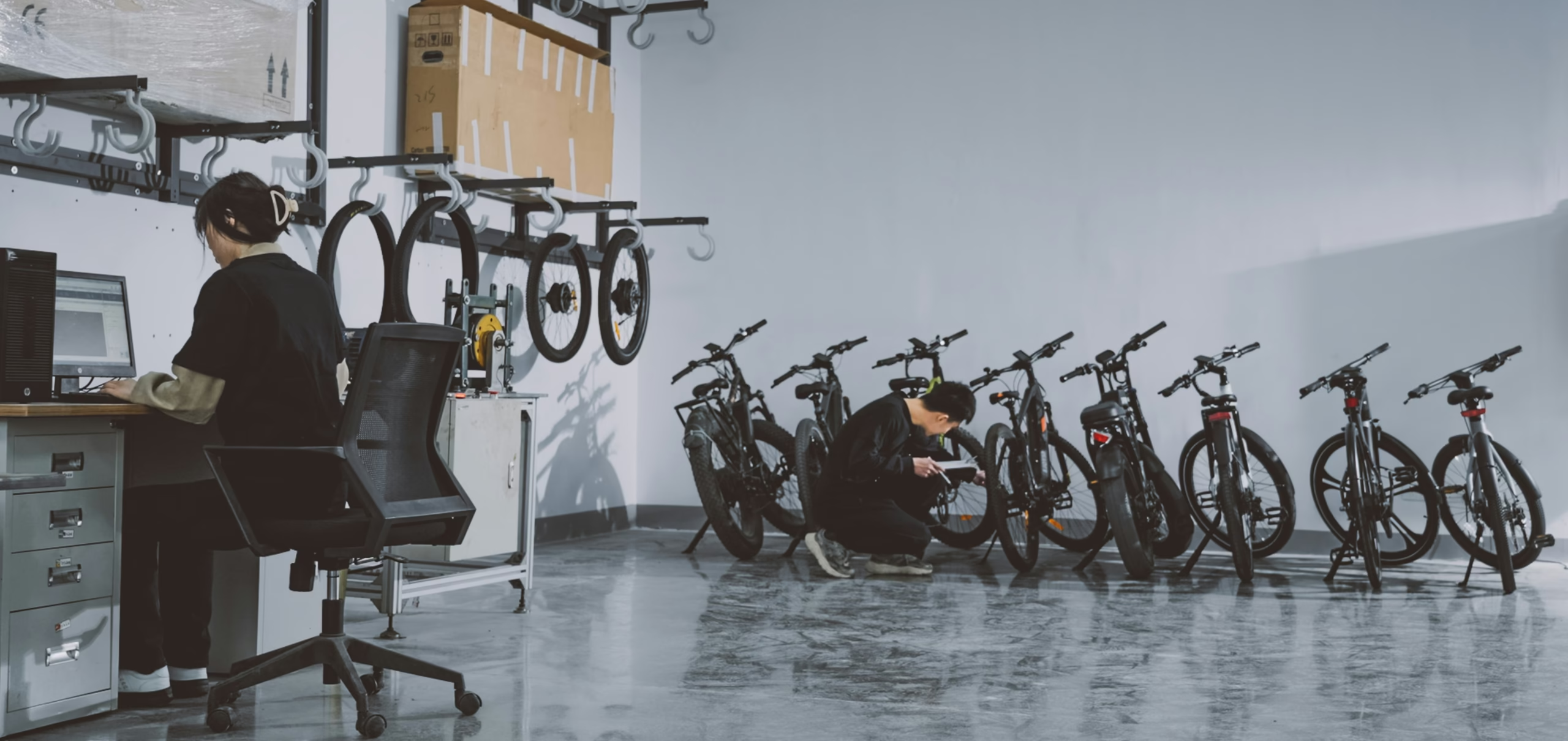
- Verify physical operations — confirm the factory exists at the claimed address, has the claimed production capacity, and operates the claimed production lines
- Assess production capability — confirm the factory has the equipment, workforce, and processes to produce your specific product category
- Review quality control systems — confirm the factory has documented QC procedures, in-process inspection, and pre-shipment inspection
- Verify compliance posture — confirm the factory holds relevant certifications (ISO 9001, BSCI, Sedex, OEKO-TEX for textiles) and can produce audit reports
Audit methods:
- On-site audit by third-party inspector ($300-800) — the gold standard; produces a 30-50 page audit report
- Video audit via Zoom or WeChat — lower cost ($0-200); less reliable than on-site
- Self-reported audit by factory — free; lowest reliability; should be cross-verified with other sources
What to verify with any factory quote:
- Production line count — the number of production lines the factory operates
- Worker headcount — total employees and shift structure
- Annual revenue range — claims of multi-million dollar revenue should be verifiable
- Major customer references — verifiable references from known brands or retailers
Phase 3: Certification review (5-15 days)
Certification objectives:
- Verify required certifications — confirm the factory holds the certifications required for your target market
- Verify certification scope — confirm the certification covers the specific product category and not just a related category
- Verify certification currency — confirm the certification is current (not expired) and has been recently audited
Common certifications for outdoor gear:
- ISO 9001 — quality management system; relevant for most factory types
- OEKO-TEX Standard 100 — textile safety; required for EU sale of textile products
- BSCI or Sedex — social compliance audit; required by many EU retailers
- CPSC compliance — US consumer product safety; required for products with safety implications
What to verify with any factory quote:
- Certification number — verifiable on the certification body’s public database
- Certification expiry date — must be valid for at least 12 months from the planned production date
- Last audit date — within the last 12 months is preferred; older audits may not reflect current state
Phase 4: Reference checks (5-10 days)
Reference check objectives:
- Verify past performance — confirm the factory has delivered on previous orders with other buyers
- Assess communication patterns — speak with current customers about typical communication frequency and quality
- Identify known issues — ask about specific issues that have arisen and how the factory resolved them
Reference source priority:
- Direct references from the factory — verify by contacting the named buyers directly
- Industry references from trade associations — more reliable than factory-direct references
- Public reviews on B2B platforms — useful but should be cross-verified
What to verify with any factory quote:
- 3-5 references from direct customers — should include contact information and permission to contact
- Order history with the references — total order count and value over the past 12-24 months
- Major customer retention rate — the percentage of customers who placed repeat orders
- Business license — Chinese business registration; verify the legal entity name matches the production site
- Export license — required for direct export; verify the factory holds its own export license or works through a trading company
- Signed NDA — protects your product designs and brand identity
- Sample approval sheet — documents the approved sample as the reference for production
- Production agreement — defines quality standards, delivery terms, payment terms, and warranty obligations
Common mistakes when vetting suppliers
Three patterns show up repeatedly in B2B sourcing conversations:
- Skipping the on-site audit — relying on video audits or self-reported information; produces surprises during production
- Ignoring communication patterns — fast initial response but slow follow-up; signals future issues
- Not verifying certifications — taking factory claims at face value; certification fraud is a documented issue in the industry
Spec callouts by supplier category
Beyond the three common mistakes, three supplier-category-specific callouts are worth flagging:
- Trading companies: verify the underlying factory relationship; trading companies often switch factories between orders
- Direct factories: verify the export license; some factories cannot export directly and route through trading companies
- Joint ventures: verify the ownership structure; quality control authority may be split between partners
Volume thresholds for supplier qualification
The volume threshold to justify a supplier qualification process differs by category:
- First-time supplier at small volume: 1,000-5,000 unit order is sufficient for initial vetting
- Mid-market supplier at growing volume: 5,000-20,000 unit order requires full four-phase vetting
- Strategic supplier at high volume: 20,000+ unit order requires annual audit and quarterly review
For more detailed sourcing guidance on supplier selection, see our wholesale outdoor gear process page.
Bottom line for sourcing teams
The four-phase vetting process (factory audit, sample evaluation, certification review, reference checks) is the dominant baseline for supplier qualification. A supplier that passes all four phases with documented deliverables is typically 20-30% more reliable than a supplier that skips or abbreviates one phase.
Budget $500-1,500 per supplier for the full vetting process. The investment pays back through reduced returns, fewer delays, and lower warranty claims. Order a 100-500 unit pilot run as the final validation before committing to a 5,000+ unit production run.
About the Author
The AnttifySport Sourcing Team supports wholesale buyers, importers, and brand owners sourcing camping, hiking, cycling, and skiing gear from qualified factories. We’ve worked with over 200 B2B clients across North America, Europe, and Australia since 2018, with a focus on low-MOQ custom orders and OEM/ODM partnerships for emerging outdoor brands.
Have a sourcing question or want to discuss your next product line? Reach out at https://www.anttifysport.com/contact/.
Further reading & sources
Related guides on AnttifySport and the public data sources referenced in this article.
- 📖 OEM / ODM services catalog — current AnttifySport factory partnership model.
- 📖 2026 North America Outdoor Gear Wholesale Market: 5 Trends — broader market context.
- 📖 How to Choose Hiking Socks for Different Climates — companion product guide.
- 📖 Camping Tent Buying Guide 2026: 4-Season vs 3-Season — companion product guide.
- 📖 Carbon Fiber vs Aluminum Trekking Poles — companion product guide.
- 🔗 BSCI (Business Social Compliance Initiative) — independent social compliance audit standard.
- 🔗 OEKO-TEX Standard 100 — independent textile safety certification.
Sources cited in this article:
- ISO 9001:2015 quality management system standard
- OEKO-TEX Standard 100 certification database
- BSCI (Business Social Compliance Initiative) audit framework
- Sedex Members Ethical Trade Audit (SMETA) framework
- US Consumer Product Safety Commission (CPSC) compliance guidelines
Public data sources cited; readers should verify specific certification claims, audit timing, and reference quality against your supplier’s current documentation and latest editions of these standards before committing to a supplier partnership. Vetting time ranges cited are industry-typical and not guaranteed for any specific supplier.
Related Products from AnttifySport
Browse the AnttifySport catalog for outdoor gear covered in this article. All products shown here are part of our wholesale lineup — wholesale pricing, low MOQ, and OEM/ODM support available. Contact our team for quotes.